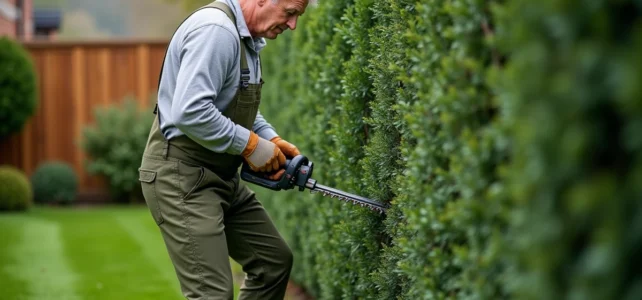
The electric hedge trimmer market has fragmented in recent years with the proliferation of battery platforms and wired models at very variable prices. Price differences range from one to twenty depending on the manufacturers, making comparison difficult without a technical reading grid. Choosing an electric hedge trimmer suitable for your garden requires understanding a few parameters that go beyond the simple question of the displayed power.
Battery platform or wired: a choice that conditions everything else
The first decision is not about the model, but about the power source. A wired electric hedge trimmer remains lightweight, quiet, and inexpensive. Its main limitation is the cable, which restricts the working radius and requires constant vigilance to avoid cutting it.
The battery-powered hedge trimmer offers greater freedom of movement. Manufacturers are now directing their development towards battery platforms compatible with multiple garden tools (lawnmower, brush cutter, blower). Choosing a hedge trimmer based on a battery already owned helps reduce the overall cost and avoid the accumulation of incompatible chargers. A comparative guide like the one offered on taille-haie-electrique.com helps identify ranges sharing the same platform.
For a modest-sized garden with an accessible outlet, the wired option remains relevant. As soon as the hedge exceeds twenty linear meters or the terrain has distant corners, the battery simplifies the work.
Tooth spacing and cutting diameter: the underestimated technical criterion
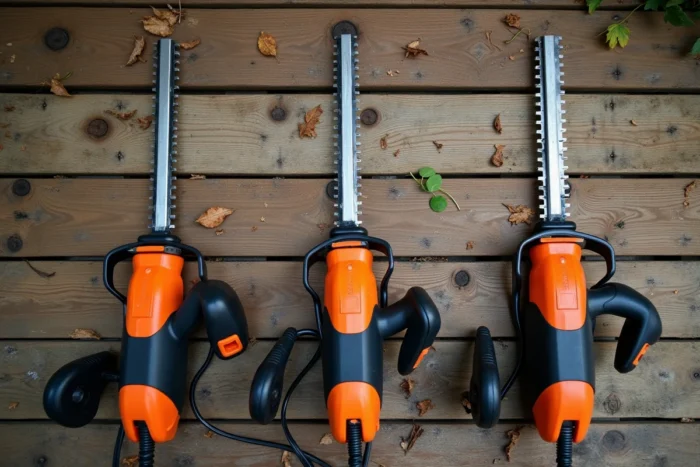
The power of the motor often captures all the attention. It matters, but the spacing of the teeth determines the maximum diameter of branches that the device can cut. Two models with the same power will not handle the same vegetation if their teeth are spaced differently.
A reduced spacing is suitable for young hedges or topiaries made up of species with fine branches (privet, boxwood, hornbeam). For older, denser hedges with woody branches, a wider spacing becomes necessary to avoid clogging and premature wear of the blades.
Blade length according to hedge height
Short blades (around 40 to 50 cm) offer more maneuverability for sculpted shapes or small spaces. Long blades (60 cm and more) speed up work on straight hedges but make the device heavier and complicate finishing at angles.
- Low hedge or topiary: short blade, reduced spacing, lightweight one-handed model if possible
- Medium straight hedge (thuja, laurel): intermediate length blade, sufficient power for semi-woody branches
- Tall or old hedge with thick branches: long blade, wide spacing, or even pole hedge trimmer to reach the top without a ladder
Adapting the blade to the profile of the hedge prevents straining a device that is undersized, which reduces fatigue and prolongs the motor’s lifespan.
Weight, ergonomics, and fatigue: what technical sheets do not show
A hedge trimmer is held at arm’s length, often in a high position for several minutes. The actual weight in use includes the battery, which can add several hundred grams compared to the “naked” weight listed on some product sheets.
Beyond weight, mass distribution plays a direct role in fatigue. A rotating handle allows the blade to be oriented without twisting the wrist during vertical cuts. Some models feature a pivoting rear handle that facilitates transitioning from the top to the side of the hedge without repositioning the whole body.
Field feedback varies on this point: a heavier but well-balanced device can prove less tiring than a lightweight model with a center of gravity that is too far forward. Handling the tool for a few minutes before purchase, when possible, remains the best test.

Trimming schedule and impact on device choice
The LPO and the French Office for Biodiversity recommend avoiding any severe trimming between March 15 and July 31, the nesting period for birds in hedges. This constraint modifies the equipment logic.
During this window, only light maintenance is desirable: trimming tender shoots, fine surface cuts. A compact battery model with a short blade is sufficient for these interventions. Major reduction work, which requires more power and wider tooth spacing, is concentrated in the autumn and early winter.
Adapting the tool to the season rather than the other way around
Rather than seeking a universal device, some gardeners have two configurations: a small battery hedge trimmer for regular maintenance and a more powerful model (wired or gas) for winter structural trims. The cost of a second entry-level device remains lower than that of a damaged blade from inappropriate use.
- March to July: light maintenance, compact model, short blade
- August to February: shaping and reduction trims, powerful model, long blade
- Check for nests before any intervention, even outside the official period
Accessories and safety: what makes the difference in use
Not all hedge trimmers come with the same equipment. A blade sheath, shoulder harness, or collector for cut branches changes the comfort of use without appearing in price comparisons. Comparing with equivalent equipment avoids unpleasant surprises on the final cost.
On the safety side, the dual trigger system (two-handed start) is standard on most recent models. Protective goggles and gloves are still necessary: flying fragments of vegetation at face height are common, especially when trimming dry hedges at the end of the season.
The choice of an electric hedge trimmer should be considered as a system (battery, blade, ergonomics, schedule) rather than as an isolated purchase. A well-sized device for the type of hedge and the season of use will last longer and require less effort, which is as important as the raw power displayed on the packaging.