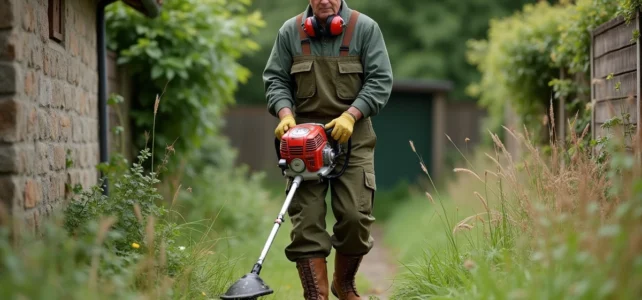
The brushcutter market is undergoing a period of restructuring. Battery models are gaining ground over gas-powered ones, legal obligations for brush clearing are extending to new departments, and shared battery ranges between garden tools are changing the purchasing logic. Choosing a brushcutter suitable for your garden requires going beyond the simple criterion of power to include less visible parameters: battery compatibility, actual type of vegetation, frequency of use, and overall cost over several seasons.
Battery ecosystem: a decisive purchasing criterion for the brushcutter
The raw power of the engine is not enough to differentiate brushcutters. Field feedback shows that the best brushcutter is often the one that integrates into an existing tool park, as it reduces additional purchase costs and simplifies battery management.
Brands like Ryobi and Stihl now offer complete ranges sharing the same batteries. Specifically, a gardener who already owns a battery-powered hedge trimmer or blower in a given ecosystem can purchase the brushcutter in a “bare” version (without battery or charger), for a price significantly lower than the complete kit. Over several tools, the cumulative savings become significant.
This reasoning requires checking the voltage and capacity of the battery first. Recent models recommend a capacity of at least 4 Ah for regular use, with the possibility of chaining sessions thanks to interchangeable batteries. A specialized catalog like the one available at debroussailleuse-warrior.com allows for comparing compatibilities between models and battery ecosystems.

Vegetation and power thresholds: where to set the bar for brambles and young wood
The type of vegetation to be managed directly influences the choice of cutting system and the required power. Guides often settle for a binary distinction (fine grass versus brush). The reality on the ground is more nuanced.
Nylon line, blade, or disc: a choice dictated by the stem to be cut
- Nylon line (round or square) is suitable for soft grasses and edge finishing. It reaches its limits as soon as the stem exceeds the consistency of a thick grass.
- The two or three-tooth blade is essential for brambles, woody nettles, and tall grasses with rigid stems. It requires higher engine power to maintain its rotational speed.
- The multi-tooth disc (saw type) allows for tackling young wood and shrub regrowth. Its use requires a suitable harness and a machine capable of sustaining prolonged effort without losing power.
A common pitfall is purchasing a “entry-level” versatile model that theoretically accepts several cutting heads but the motor lacks torque to effectively use a blade or disc. The result: a nylon line used by default, even on brambles, leading to rapid wear and poor work quality.
Frequency and area: two related variables
A secondary residence garden left fallow for several months requires a machine capable of mowing tall grasses and woody regrowth over long sessions. Power and autonomy (for battery models) or tank capacity (for gas models) then become decisive criteria.
Conversely, a regularly maintained garden, where the brushcutter is mainly used to finish what the mower cannot reach (fence feet, flowerbed edges, slopes), primarily demands maneuverability and a manageable weight. The weight of the machine directly influences fatigue and precision of movement during repeated finishing sessions.
Gas or battery brushcutter: current state of the power balance
The performance gap between gas models and battery models is narrowing each year, even though gas still has the advantage for intensive long-duration sessions.
Next-generation battery models, with high voltages and capacities of 4 Ah or more, reach power levels that would have been reserved for gas models a few years ago. This upgrade is a recent market evolution, and comparisons published two or three years ago show performance gaps that no longer correspond to current models.
However, for prolonged brush clearing sessions over large fallow areas, gas retains a practical advantage: refueling takes just a few seconds, while recharging a battery requires a break or the purchase of additional batteries. Field feedback varies on this point depending on whether the user has one or two spare batteries.
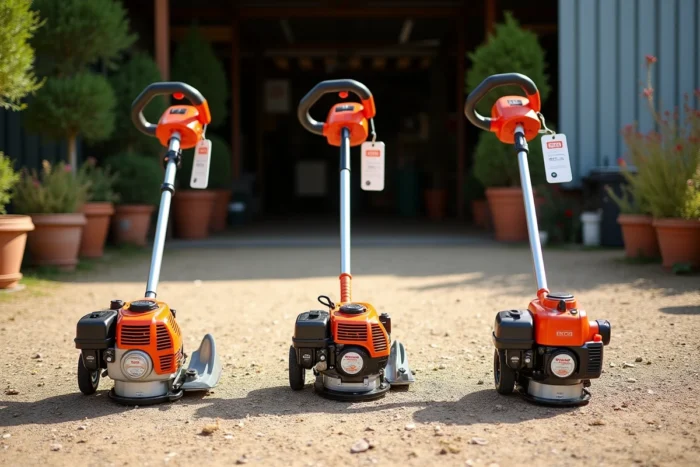
Legal obligations for brush clearing: a regulatory criterion to consider
The regulatory framework for brush clearing is evolving. The obligation to clear brush is gradually extending to new departments, linked to the increasing fire risk. This extension modifies the needs of many owners who, until now, were satisfied with a simple trimmer.
Mandatory brush clearing involves heavier and more frequent operations: mowing tall grasses, trimming shrubs, pruning trees, and disposing of debris. This level of demand justifies the choice of a versatile brushcutter, capable of accepting multiple types of cutting heads, rather than a device limited to finishing work.
For affected owners, the power criterion is no longer a luxury but a functional necessity. An undersized model will require multiple passes, increase equipment wear, and significantly extend working time.
The choice of a brushcutter ultimately hinges on three concrete axes: compatibility with an existing battery ecosystem, the suitability between cutting system and actual vegetation, and consideration of local regulatory obligations. A purchase guided by these criteria avoids the pitfalls of a technically correct device that is unsuitable for daily use.