
The distinction between grammatical class and syntactic function remains the main sticking point in middle school. Confusing the nature of a word with its role in the sentence leads to cascading errors, from the agreement of the past participle to logical analysis in 9th grade. Corrected exercises are useless if they do not target this specific knot.
Syntactic manipulations: the forgotten foundation of exercises on grammatical classes
The French curriculum in middle school now organizes the study of the language around three explicit syntactic manipulations: deletion, movement, and substitution. Identifying an adverb or a circumstantial complement no longer involves a definition learned by heart, but rather a concrete test on the sentence.
Deletion checks if a group is optional. Movement distinguishes a circumstantial complement (mobile) from a direct object (fixed after the verb). Substitution, in turn, confirms the grammatical class: replacing a noun phrase with a pronoun proves that it is indeed a noun phrase, not a poorly identified subordinate clause.
We recommend structuring each corrected exercise around these three operations rather than offering simple identification. A student who knows how to delete, move, and substitute no longer needs to memorize lists of prepositions or conjunctions: they identify them by their behavior in the sentence. Several resources compile corrected grammar exercises on Emploi Annonces according to this manipulative logic.

Weekly language rituals: why isolated exercises are no longer sufficient in grammar
Recent guidelines in the French curriculum favor weekly language rituals rather than one-off sessions. Daily dictation, erroneous statements to correct, dictations of various modalities: the goal is automation, not performance on a single exercise.
An exercise on grammatical classes done once a month creates no reflex. The student succeeds on the day, then loses the skill in two weeks. The short ritual (five to ten minutes at the beginning of class) anchors the recognition of word types in procedural memory.
Building an effective ritual around grammatical analysis
The most productive format relies on a single sentence analyzed in depth. We observe that long corrections covering twenty sentences produce less progress than a single sentence dissected collectively with the three manipulations.
- Project a complex sentence containing at least one conjugated verb, one pronoun, and one preposition. Ask for the grammatical class of each word before any discussion on function.
- Introduce an intruder: modify a word in the sentence (replace an adverb with an adjective, for example) and observe the change in meaning or construction. This forces the distinction between nature and function.
- Propose a deliberately faulty sentence where a noun complement is confused with an indirect object. The student must apply pronoun substitution to decide.
The error corrected in context fixes the rule better than ten fill-in-the-blank exercises. This principle aligns with the trend toward contextual revision rather than mechanical identification.
Diagnostic assessment of grammatical classes in 9th grade: a benchmark for calibrating exercises
Official positioning resources show that, as early as 9th grade, targeted French assessments include a specific module on “grammatical classes”. This skill is treated as a standalone diagnostic axis, not as a sub-theme drowned in general grammar.
For a student preparing for these assessments, corrected exercises must cover variable classes (noun, determiner, adjective, pronoun, verb) and invariable classes (adverb, preposition, conjunction, interjection). We find that the most frequent gaps focus on three specific areas.
Three recurring confusions to target in middle school grammar exercises
- Qualifying adjective and past participle used as an adjective. “Fatigué” in “l’élève fatigué” is not a verb. The test: can it be conjugated in this position? No, it is an adjective.
- Preposition and adverb. “Avant” is a preposition in “avant le cours,” an adverb in “il est arrivé avant.” The deletion manipulation distinguishes: the adverb is removable, the preposition leaves an incomplete group.
- Subordinating conjunction and relative pronoun. “Que” in “je pense que tu comprends” (conjunction) versus “le livre que tu lis” (relative pronoun, replaceable by “lequel”). Substitution is the only reliable test.
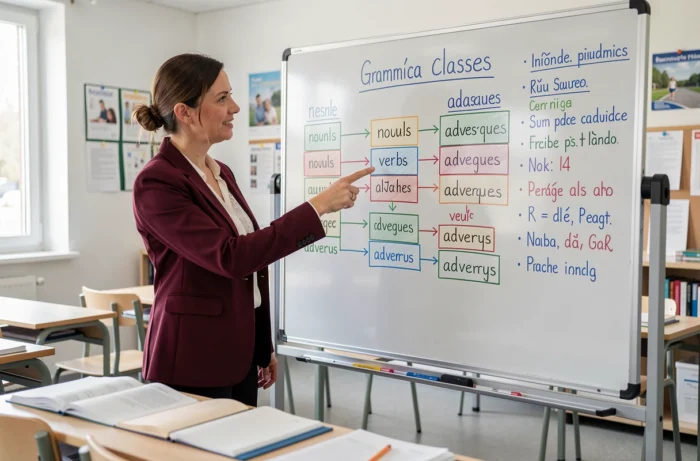
Sentence and noun group: the two levels of analysis for progress in grammar
A structured syntactic progression distinguishes two complementary levels of analysis. At the sentence level, we work on functions (subject, direct object, indirect object, circumstantial complements). At the level of the noun group, we analyze expansion: epithet, noun complement, relative subordinate clause.
The most useful corrected exercises navigate the student between these two levels on the same sentence. Take “Le chat noir du voisin dort sur le canapé.” At the sentence level: “le chat noir du voisin” is the subject, “sur le canapé” is a circumstantial complement of place. At the level of the subject noun group: “noir” is an epithet (adjective), “du voisin” is a noun complement (prepositional group).
This dual reading prevents confusion between nature and function. The adjective “noir” has a fixed grammatical class, but its function changes according to its position: epithet linked in “le chat noir,” subject attribute in “le chat est noir.”
A corrected exercise that does not show this shift between the two levels misses the objective. The grammatical class is permanent, the function depends on the sentence: this is the rule that every correction should emphasize, regardless of the middle school level.