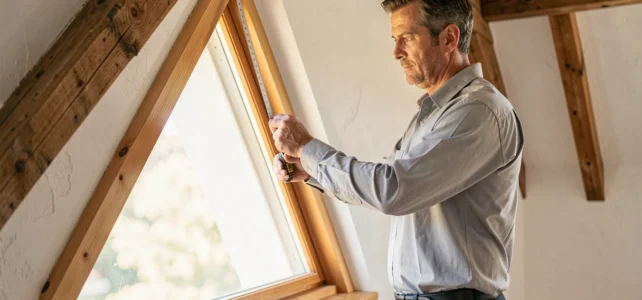
A triangular gable window lets in a lot of light, but it presents a concrete problem when you want to equip it with a roller shutter. The slanted shape prevents the installation of a standard box and tracks. The standard curtain, made of horizontal slats of the same width, cannot follow an oblique line without specific adaptation. Choosing a roller shutter suitable for a triangular window requires understanding some technical constraints before getting started.
Triangular window and overheating: a regulatory issue often overlooked
Triangular gable windows are often oriented directly south or west. Their glazed surface, sometimes very generous, captures solar radiation intensely in the summer.
Since the implementation of RE2020, summer comfort is measured by an indicator called DH (degree-hours). It counts each hour where the indoor temperature exceeds an adaptive threshold, particularly around 26 °C at night. Exceeding a certain level of DH penalizes the construction project.
External solar protections, including roller shutters, can block up to 90% of solar radiation before it passes through the glazing. On a heavily glazed gable, the trapezoidal roller shutter is therefore no longer just about comfort: it directly contributes to the regulatory compliance of the building.
When considering a roller shutter for a triangular window, this thermal parameter should weigh as much as aesthetics in the decision-making process.
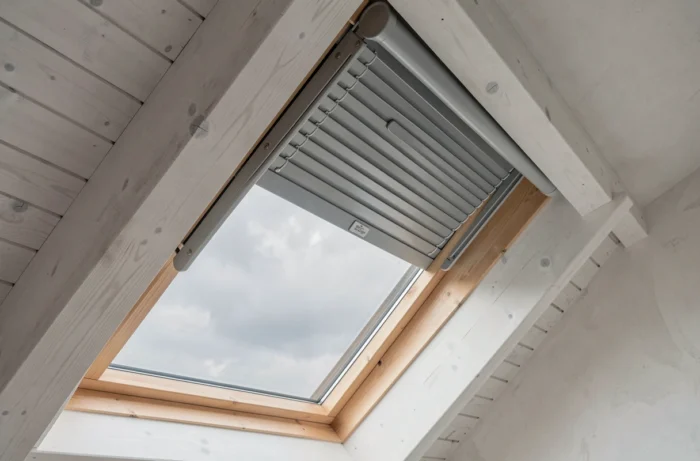
Trapezoidal roller shutter: how the curtain works on an oblique shape
A classic roller shutter descends vertically between two parallel tracks. The curtain is made up of identical slats. On a triangular window, this logic no longer works: one side of the window is shorter than the other, or even reduced to a simple peak.
The principle of the cross-section cut
The most common solution is to cut the slats on a slant. Each slat has a different length, allowing the curtain to follow the slope of the triangle. The rolling box remains horizontal, positioned at the top of the window. On the track side, one is vertical and the other follows the oblique line of the frame.
This system requires custom manufacturing for each opening. There are no trapezoidal shutters in standard dimensions. The measurement must be precise, ideally carried out by the carpenter who will make the shutter.
Box at the top or box at the bottom
You may have noticed that some manufacturers offer a box installed under the window, with a curtain that rises. This inverted installation is sometimes mentioned for very acute triangles where the upper box would be too narrow to house the roll. This type of mechanism remains rare and more expensive, but it solves a real geometric problem on steep gables.
Concrete criteria for choosing the right shutter for a slanted window
Before requesting a quote, three parameters should be decided in advance. They determine the type of product, the budget, and the feasibility of the installation.
- The angle of the triangle’s slope. Below a certain degree of inclination, the slats cut on a slant remain functional. On a very acute triangle, the slats become so short on one side that they struggle to slide. The manufacturer must verify that the geometry of your window is compatible with their system.
- The maximum width of the curtain. Some trapezoidal systems limit the total width to about two meters. Beyond that, it is necessary to consider two coupled shutters, which complicates visual harmony with the windows below.
- The type of motorization. A motorized trapezoidal shutter requires a motor capable of managing the rolling of slats of different lengths. The tension of the curtain is not uniform, which requires fine adjustment of the end stops. A standard tubular motor may be suitable, but its power must be adapted to the total weight of the custom curtain.

Material of the slats: aluminum or PVC for a triangular window
The choice of material influences both thermal insulation and behavior in the heat.
Aluminum is the most common material for trapezoidal shutters. Double-walled aluminum slats filled with insulating foam offer a good compromise between lightness and rigidity. On a large triangular window, the lightness of aluminum facilitates rolling and reduces the strain on the motor.
PVC, more affordable in price, remains feasible on modest-sized windows. However, PVC slats expand more under the effect of heat, which can pose a problem on a gable that is very exposed to the sun. On a large glazed surface facing south, aluminum remains the most reliable choice.
The color of the shutter also plays a role. A recent technical article on heat management by roller shutters reminds us that a light-colored shutter reflects radiation better than a dark one. On a highly exposed triangular gable, choosing a light shade significantly reduces overheating of the slat itself and the air between the shutter and the glazing.
Installation of a trapezoidal shutter: what the carpenter needs to check
Installing a roller shutter on a triangular window is not something that can be improvised. Two technical points must be validated before ordering.
The first concerns the available space for the box. On a gable, the lintel at the top of the triangle can be very narrow. If the box does not fit, you must either opt for an external box (applique) or consider the inverted installation with the box at the bottom.
The second point concerns the fixation of the tracks. The oblique track must be perfectly aligned with the slope of the frame. A gap of a few millimeters is enough to block the curtain. Laser measurement is recommended rather than a simple tape measure.
A triangular window equipped with the right trapezoidal roller shutter transforms an attic room into a comfortable space all year round. Customization comes at a cost, but it remains the only approach that respects both the geometry of the structure and current thermal requirements.