
The Wobbel balance board is one of those objects whose apparent simplicity hides a precise design. A curved wooden board, without buttons, screens, or batteries, it was born in the Netherlands under the impetus of Hannelore Blaauw and Wouter Haine. For several years now, it has found its way into homes, alternative schools, and psychomotor therapy practices. Its success is based on a fundamental mechanical principle: a curve that forces the body to adapt continuously.
European Regulation on Wooden Toys: What Changes for Balance Boards
Most articles about the Wobbel focus on its playful uses. Few address the regulatory framework that governs its market introduction. The new European regulation on toy safety, applicable from 2026, expands chemical prohibitions to endocrine disruptors, PFAS, and bisphenols. For a varnished or painted wooden board, this directly concerns glues, finishes, and any surface treatments.
The Wobbel brand claims to use water-based paints and varnishes, and European beech wood certified by FSC. These manufacturing choices take on new significance in light of these strengthened requirements.
Moreover, the standard EN 71-1:2026 (mechanical and physical safety), which will replace the 2014 version starting in August 2027, tightens testing on small parts, sound levels, and requires standardized age and warning pictograms on packaging. For a product intended for children from a very young age, these developments are not trivial. They determine the compliance of each model sold in the European Union.
Families considering the Wobbel balance board for their children should therefore check that the chosen model bears the updated CE marking.
Wobbel Board and Balance Development: What the Design Says
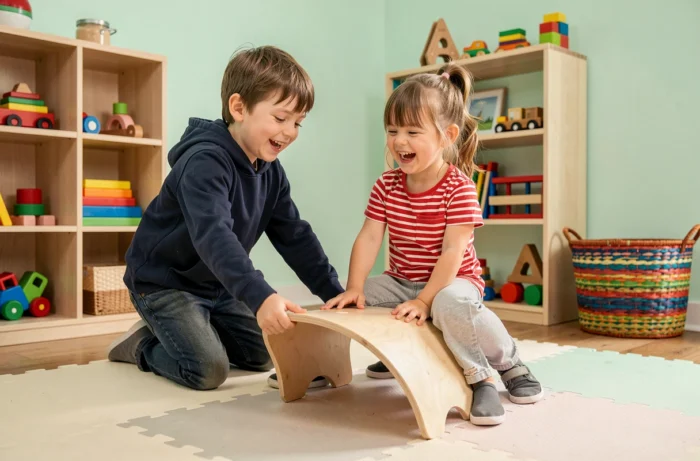
The vestibular system, responsible for the perception of balance and body position in space, develops actively during childhood. Regular stimulation through rocking movements helps refine postural coordination. This is the principle exploited by the curve of the Wobbel.
The child standing on the board must continuously adjust their weight distribution. The oscillation movement engages the stabilizing muscles of the ankles, knees, and trunk. In a sitting or lying position, the rocking produces a gentler vestibular stimulation, often compared to that of a rocking chair.
Limits to Keep in Mind
The Wobbel is not a medical device. Field feedback varies on this point: some psychomotor professionals incorporate it into their sessions, while others consider it remains a playful support among others. No specific clinical study on the Wobbel is cited by the brand to support specific therapeutic benefits.
For very young children, supervision remains essential. The unstable surface presents a risk of falling, and the height of the curve varies by model.
Wood, Felt, and Finishes: Criteria for Choosing a Wobbel Board
The Wobbel range comes in several sizes and finishes. The choice is not just a matter of aesthetics. Each variant responds to different uses and spaces.
- The felt glued under the board protects the floor from scratches and dampens the noise of oscillation, a determining factor in apartments or on parquet floors
- Raw wood, without varnish or paint, is suitable for families who wish to limit any contact with chemical products, even water-based ones
- Models with a cork coating offer a non-slip surface appreciated for bare feet and resist moisture better than felt
- The “Starter” size is aimed at the youngest children, with a less pronounced curve and a lower weight capacity, while the “Original” model supports the weight of an adult
The price of a Wobbel varies significantly depending on the model and finish. The simplest versions in raw wood remain more accessible than those with felt or paint. The available data does not allow for a reliable price range, as prices vary by retailers and countries.
Creativity and Free Play: Why a Board Without a Defined Function Works
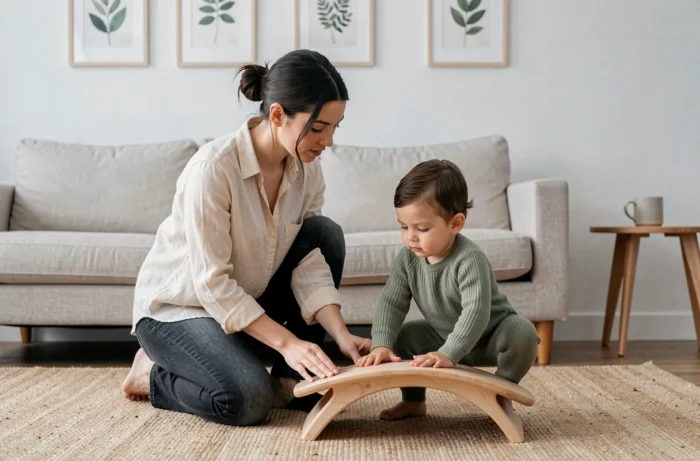
The Wobbel has no instruction manual in the traditional sense. It is an open object, inspired by Steiner-Waldorf and Montessori pedagogies, that allows the child to decide how to use it. Bridge, slide, hut, seat, cradle for stuffed animals, merchant’s counter: the absence of an imposed function stimulates the imagination.
This principle of free play is based on the idea that children learn more when they invent the rules. A toy that is too directive channels attention to a single activity. The curved board, with its neutral shape, multiplies possible scenarios without prescribing them.
An Object Shared Between Children and Adults
The Original model supports the weight of an adult. Some use it as a stretching support, yoga board, or simply a low seat for reading. This dual use distinguishes the Wobbel from most wooden toys intended exclusively for children. One product spans age ranges, making it a sustainable investment in family space.
However, this versatility has a trade-off: the board occupies a significant floor space. In a small apartment, vertical storage or a dedicated corner must be planned.
The longevity of the product also depends on maintenance. Beech wood withstands shocks well, but felt finishes wear out over time, especially if the board is used daily on rough surfaces. Replacing the felt is possible, provided a compatible piece is found from the brand or an authorized dealer.
The Wobbel board is neither a miracle toy nor just a simple piece of curved wood. It is an object whose value rests on the quality of materials, compliance with current standards, and each child’s ability to make it their own. The tightening of the European regulatory framework in 2026-2027 makes checking certifications more relevant than ever before any purchase.