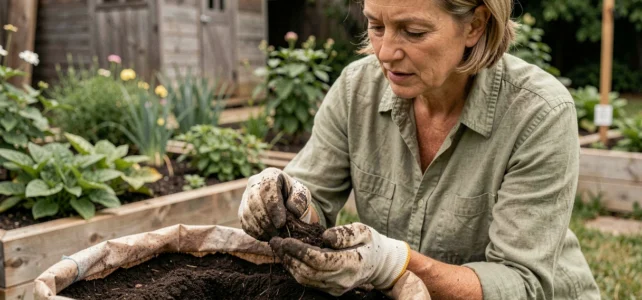
A clayey soil that sticks to your boots after every rain, a sandy soil that retains nothing, a filled plot after construction work: in each of these cases, the existing soil is insufficient. Before ordering cubic meters of topsoil, you save time and money by precisely identifying what is lacking in the existing soil.
The choice of the right topsoil for a garden depends less on a generic label than on a careful reading of the composition, grain size, and intended use.
Assessment of the existing soil before any purchase of topsoil
Bringing topsoil onto unassessed soil is like applying a bandage without knowing the wound. On clayey land, adding too fine a soil will worsen the drainage problem. On sandy soil, a soil low in organic matter will wash away with the first heavy downpour.
The most accessible test remains the soil ball test: take a handful of moist soil and squeeze it. If it crumbles immediately, the soil is sandy. If it forms a compact and sticky ball, it is clayey. A balanced soil (loamy) holds briefly and then crumbles under slight pressure.
When you want to go further, you can check the pH and nutrient levels (nitrogen, phosphorus, potassium) with an analysis kit sold at garden centers or through a laboratory. This step guides the type of soil and amendment to prioritize. A pH that is too acidic or too basic limits nutrient absorption by plants, regardless of the quality of the added soil.
To compare available offers and understand selection criteria, you can buy topsoil on Instant Jardin where the different options are detailed according to the intended use.
Screened, amended, or fill soil: choose according to the project
The term “topsoil” covers very different products. You do not plant tomatoes in the same soil used to fill a trench. Three categories dominate the market, and each meets a specific need.
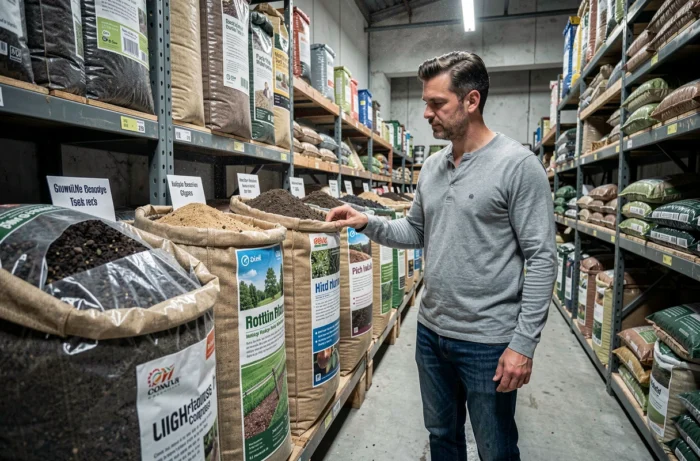
Screened soil for finishing
Screened topsoil is sifted to obtain a homogeneous grain size, free of large stones and debris. It is suitable for reseeding lawns or creating surface beds. Its thickness of use remains limited: a few centimeters for fine mesh soil, up to about twenty centimeters for coarser mesh.
Amended soil for demanding crops
Enriched with compost or organic matter, amended soil provides superior structure and nutrient richness. It is the logical choice for a vegetable garden or shrub plantings. Check the label for the percentage of organic matter and the nature of the amendment (plant compost, composted manure).
Fill soil for volume
Less noble, fill soil is used to level land or fill excavations. It is not intended to directly host crops. It is then covered with a layer of screened or amended soil.
- Lawn or reseeding: fine screened soil, in a surface layer
- Vegetable garden, beds, shrubs: amended soil rich in organic matter
- Leveling, filling: fill soil, covered with an appropriate finish
Read the label and spot common pitfalls
The term “topsoil” is not a guarantee of uniform quality. Feedback varies on this point: some soils sold under this label contain a significant proportion of heavy clay or coarse sand, without real agronomic value.
Checking the detailed composition before ordering is the only reliable precaution. Three indicators deserve particular attention:
- Grain size: soil that is too fine compacts, soil that is too coarse does not retain water. The mesh size of the screening (indicated in millimeters) gives a direct indication
- Salinity: an excess of salt in the soil blocks root growth. This parameter is rarely displayed but can be requested from the supplier
- Declared intended use: soil suitable for grassing may be unsuitable for containers or vegetable crops. The supplier must specify the recommended use
Another common pitfall: ordering a standard volume without adapting the supply to the existing soil. On clayey soil, a lighter mix with compost is preferred to break the compactness. On sandy soil, one seeks soil richer in silt and organic matter to improve water retention.
Packaging and delivery of topsoil: bulk or big bag
The choice of packaging depends on the necessary volume and the accessibility of the site. For small areas (a few square meters of beds), bags of potting soil or topsoil from a garden center are sufficient. Beyond that, one moves to big bags or bulk delivered by truck.
Bulk remains the most economical solution for large volumes. A truck delivers the soil directly to the site, avoiding the handling of bags. The constraint: there must be sufficiently wide access and temporary storage space. The big bag (about one cubic meter) offers a practical compromise when access is restricted or when an intermediate volume is needed.
Before delivery, measure the area to be covered and the desired thickness. The formula is simple: length multiplied by width multiplied by thickness gives the volume in cubic meters. It is better to allow a small margin than to find oneself short at the end of the project.
Mix rather than replace: the approach that changes results
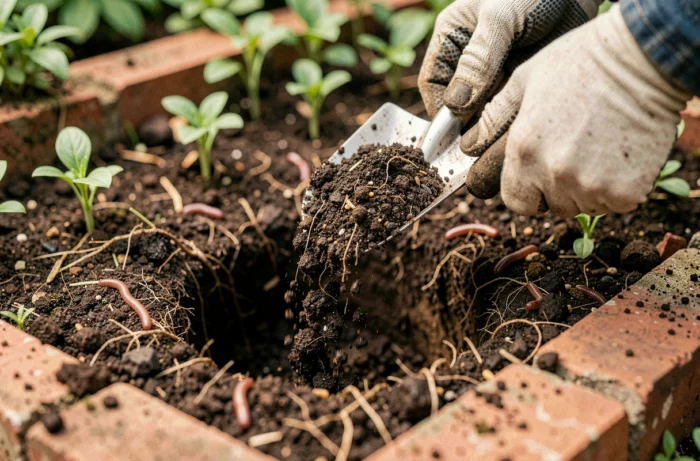
The recent trend in gardening is to no longer simply “add soil” everywhere in the same way. One works by mixing with the existing soil rather than by layering. Incorporating compost, organic matter, or amended soil into the top few inches of the existing soil yields better results than placing a new layer on a compact substrate.
For a vegetable garden, one digs or uses a broad fork to work the soil to a good depth before incorporating the amended topsoil. For a lawn, one scarifies the surface before spreading the finishing layer. The goal is to create a gradual transition between the native soil and the addition, not a sharp boundary that would prevent roots from descending.
A living soil is built over time. Quality topsoil provides the base, but it is the soil work, mulching, and regular organic additions that maintain fertility season after season.