To drive a stake into the body of a living condemned person, then leave them to die slowly: this is what the torture of impalement refers to. This method of execution, practiced on several continents and for centuries, remains one of the most feared in the history of punishments. Its precise functioning, its variants, and the political reasons for its use deserve attention, far from horrific clichés.
Mechanics of the torture of impalement: how the body was tortured
The principle seems simple, but the technical reality is much more complex. The condemned was placed on a wooden or metal stake, usually pointed but not always sharpened. The goal was not to kill quickly.
A stake that was too sharp would cause a fatal hemorrhage within minutes. The executioners sought the opposite: a rounded stake prolonged the agony for several days. The wood pushed the organs aside without cutting them, and the weight of the body slowly lowered the victim.
Some variants included a horizontal beam fixed on the stake to stop the descent at a specific point. The condemned would then remain suspended, exposed to the elements and the gaze of all. What has been documented about the torture of impalement and its tortures confirms that slowness was the very heart of the device.
Death occurred from dehydration, infection, or failure of internal organs, rarely from the initial injury itself. The agony could last from a few hours to three days depending on the technique used and the physique of the tortured.
Vlad III and the propaganda surrounding impalement in the 15th century
Why is the stake systematically associated with Vlad III, known as “the Impaler”? Because the chronicles of the time, particularly those produced by Saxon merchants from Transylvania, have fixed this image in the European collective memory.
The accounts speak of thousands of victims impaled simultaneously. However, recent studies published in the Transactions of the Royal Historical Society, conducted by historian Mihailo St. Popovic, reevaluate these figures. By cross-referencing the critique of the chronicles with the military logistical constraints of the 15th century, these studies show that the numbers were largely inflated by propaganda.
Anti-Vlad pamphlets circulated in German trading cities. They served specific political interests: to discredit a Wallachian prince who threatened Saxon commercial privileges. The impalement was real, but its scale was instrumentalized.
This case illustrates a recurring mechanism in the history of tortures: torture serves as much to punish as to communicate a political message. The spectacle of suffering targets those who watch, not just the one who endures.
Punishments by impalement: a widespread practice from antiquity to the 20th century
Reducing the torture of impalement to 15th century Wallachia would be a mistake. This form of torture appears in very different contexts over a considerable duration.
- In antiquity, the Assyrians used impalement as a military punishment against conquered populations. Bas-reliefs preserved in the Louvre depict scenes of impalement dating back to the first millennium BCE.
- The Ottoman Empire codified impalement as a legal penalty for certain serious crimes, including rebellion and banditry. Accounts from 17th-century European travelers, such as those of Jean-Baptiste Tavernier, describe these executions with a mix of fascination and horror.
- In Southeastern Europe, a case of impalement applied as a legal penalty is documented as late as 1946 in Yugoslavia, in the context of post-war retribution.
This persistence over several millennia shows that the torture of impalement is not an isolated archaic practice. It has traversed the ages because it fulfilled a specific function in penal justice systems based on public terror.
The perspective of European travelers on Eastern tortures
17th-century travel accounts are a valuable source. Tavernier and Pierre-Martin de La Martinière, two Frenchmen who traveled through the Ottoman Empire and Persia, describe scenes of torture with a gaze that oscillates between compassion and apparent indifference.
Their emotional reaction varied according to the political context of the account. When the traveler wished to highlight the “barbarity” of the East, the description became more detailed and more empathetic towards the victim. When it concerned common criminals, the tone became more neutral, almost clinical.
These texts reveal less about the reality of tortures than about how Europe constructed its view of the East. Compassion itself had a political dimension.

Torture museums in Europe: San Gimignano and the memory of tortures
Today, the memory of corporal punishments can be visited. Several European museums display instruments of torture, whether real or reconstructed. The most well-known is located in San Gimignano, Tuscany.
These places pose a question that visitors often avoid: why do we feel a fascination for torture instruments? Torture museums attract a wide audience, far beyond historians. Travel journalist Rick Steves recently dedicated an article to the continent’s “torture museums,” highlighting their tourist popularity.
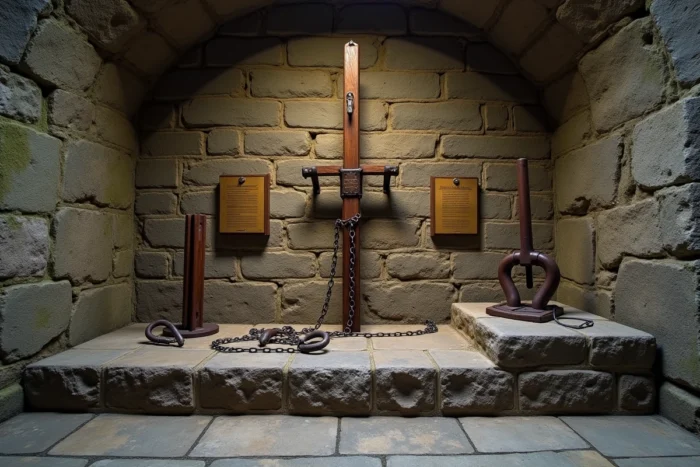
The displayed objects (iron cages, racks, pincers) allow for a materialization of what historical texts describe abstractly. Seeing the size of a stake, touching the texture of the metal of a cage, understanding the space in which a body was confined: the object makes cruelty concrete in a way that text alone cannot.
San Gimignano, in Italy, also attracts visitors because the Tuscan medieval setting creates a striking contrast between the beauty of the place and the horror of what was practiced there. The torture did not take place in a dark setting: it occurred in broad daylight, in the public square, before ordinary spectators.
The history of tortures and executions does not belong to a bygone past. The mechanisms that made them possible, the dehumanization of the condemned, the spectacular dimension of punishment, the political use of suffering, remain relevant frameworks for understanding documented practices well beyond the Middle Ages.