
Solerys is a private placement operator (PPO) mandated by France Travail to provide employment support services. Its uniqueness lies in the diversity of its programs and the contractual framework that links the beneficiary to the public institution, not to the service provider itself. Here, we detail the concrete mechanisms of this support, the recurring areas of ambiguity, and what beneficiaries actually gain from it.
Solerys private operator: the logic of subcontracting and its consequences for the beneficiary
The point that most articles gloss over is the exact nature of the legal link between the job seeker and Solerys. Solerys is not a service of France Travail; it is an external provider affiliated with the Oasys and Cie group, specializing in redeployment and professional mobility for over thirty years. France Travail remains the administrative ordering party.
This distinction has a direct impact on the rights of the beneficiary. In case of absence from a Solerys appointment, the provider reports the failure. The decision to suspend benefits or to deregister is exclusively the responsibility of France Travail. Solerys has no independent sanctioning power, which is often misunderstood by summoned individuals.
Solerys consultants operate under a results-based logic with variable remuneration, which implies quantified placement objectives and a sustained follow-up pace. The job offers published by Solerys to recruit its own consultants confirm this operational pressure, with multi-site positions and performance indicators. This mechanism partly explains the mixed feedback experiences.
To delve deeper into this subject, the reviews on Solerys Pôle emploi collected from beneficiaries shed light on the diversity of lived experiences.
Solerys France Travail services: four programs, four different experiences
Reducing Solerys to a single type of support is a common mistake. The provider operates across several distinct services, and feedback varies significantly depending on the program to which the beneficiary is assigned.
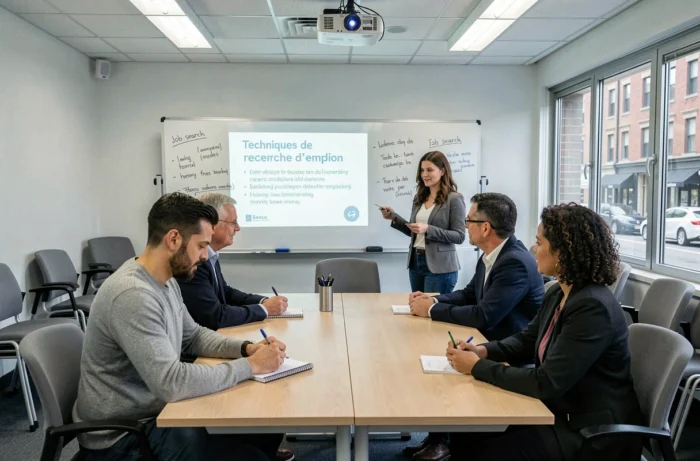
- Return to classic employment: individual and group support towards a salaried position, with job search technique workshops, interview simulations, and connections with recruiters.
- Business creation or takeover: a dedicated path for job seekers with an entrepreneurial project, including feasibility analysis and assistance in developing a business plan.
- Mobility and professional retraining: working on the professional project, market-oriented skills assessment, and identification of sectoral bridges.
- Executive support: a specific service with market positioning tailored to experienced profiles and remuneration challenges.
A beneficiary directed towards the “business creation” service and another in “return to classic employment” do not experience the same journey. Global criticisms of Solerys often conflate these programs, which skews the analysis.
Referral to a program: how France Travail decides
The referral to Solerys is not random. It is part of the Personalized Employment Access Project (PPAE) and depends on the job seeker’s profile, their duration of registration, their sector of activity, and the availability of services in the relevant job market. The job seeker generally does not have a choice of provider.
Since the institutional shift to France Travail, the management of referrals to PPOs has been refocused as part of the full employment reform. The supported populations have expanded, and the rise of external operators like Solerys has intensified.
Solerys follow-up and attendance obligation: what the job seeker risks
The Solerys appointment is mandatory as soon as it is included in the job seeker’s PPAE. Failing to attend without a legitimate reason triggers a report to the competent France Travail service.
France Travail alone retains the power of administrative decision regarding deregistration or suspension of benefits. The process involves a warning, followed by a possible temporary suspension of the benefit. The procedure is identical to that applied for absence from a standard France Travail appointment.
A rarely mentioned point: within the framework of the Professional Security Contract (CSP), follow-up obligations are strengthened. A CSP beneficiary who refuses Solerys appointments risks losing the professional security allowance, which is more advantageous than the standard ARE. The cost-benefit calculation clearly favors participation.
Feedback on Solerys: what emerges from beneficiary testimonials
We observe a clear polarization in the feedback. Satisfied beneficiaries consistently mention the relational quality of the assigned consultant, the regularity of follow-up, and the relevance of the offers made. Dissatisfied individuals point to standardized support, group workshops poorly suited to their profile, and a feeling of control rather than support.

This polarization directly reflects the operational pressure on Solerys consultants. An overloaded consultant, with too large a portfolio, mechanically produces less personalized follow-up. The multi-site operation exacerbates this phenomenon.
Maximizing the usefulness of the Solerys journey
The beneficiary’s approach significantly changes the situation. Arriving at the first appointment with an updated CV, a clear idea of the target sector, and specific questions about the local market allows the consultant to provide concrete support rather than generic workshops.
Explicitly requesting the type of service one falls under (return to employment, retraining, business creation) and verifying that the program aligns with one’s actual project is a lever often overlooked. In case of a clear mismatch, a discussion with the referring France Travail advisor can lead to a reorientation.
The Solerys program functions as a framework. Its value depends as much on the consultant’s competence as on the beneficiary’s ability to use this framework to advance towards specific objectives. Passive support remains sterile; invested support can accelerate a return to employment, especially for profiles lacking a network or visibility in their market.