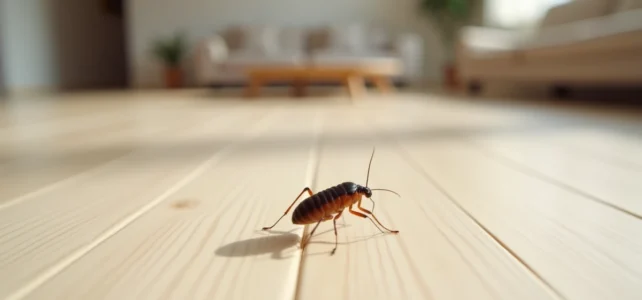
A black dot jumps on the bathroom tiles, another disappears between the floorboards. The reflex is often the same: to immediately think of fleas. This automatic association, however, leads to inappropriate treatments in a significant number of cases, because several very different species share this jumping behavior and this dark appearance.
Springtails or fleas: the confusion that skews the diagnosis
The majority of identification errors comes from a simple shortcut: small, black, it jumps, therefore it’s a flea. Several pest control professionals report that springtails are confused with fleas in a large number of home interventions.
The springtail does not bite, does not sting, does not live on the skin or in bedding. It feeds on microscopic molds and decaying organic matter. Its presence indicates a humidity problem, not a parasitic issue.
The flea, on the other hand, produces clustered bites, often localized on the ankles and lower legs. Its jumps are significantly larger, sometimes several dozen centimeters, whereas the springtail makes short, low jumps. When trying to identify a small black jumping bug, these two criteria (bites and jump amplitude) help to distinguish in most situations.
A third reliable clue: the location. Springtails appear near shower joints, on window sills, in the waterlogged soil of houseplants. Fleas concentrate in carpets, rugs, pet cushions, and floorboard cracks.
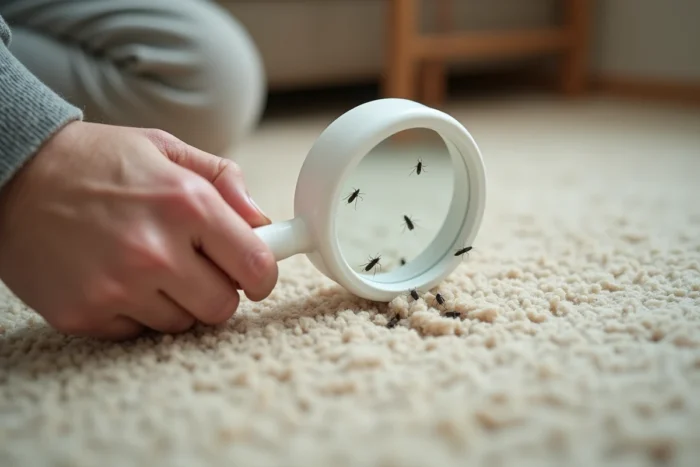
Small black jumping bug: three clues for a reliable diagnosis
Before buying an insecticide or calling a professional, a methodical observation of a few minutes is enough to guide the diagnosis. Here are the three points to systematically check.
- The bodily context: itching, traces of bites aligned in twos or threes on the ankles or arms point to fleas. The total absence of bites almost systematically excludes fleas and points towards springtails, psocids, or thrips.
- The area of appearance: a bathroom, a basement, a poorly ventilated cellar, or a waterlogged flower pot indicate an insect related to humidity (springtail, psocid). A living room with carpet, a dog’s nook, or an old sofa points towards fleas.
- The size and behavior: springtails often measure less than two millimeters and jump thanks to a specific organ (the furca) folded under the abdomen. Fleas are slightly larger, flattened laterally, and quickly flee into textile fibers.
This observation grid requires no equipment. It mainly avoids treating a humidity problem with a pesticide, which resolves nothing and unnecessarily exposes the home to chemicals.
Humidity and mold: the real signal behind springtails
Springtails are not a problem in themselves. Their presence is a biological indicator of excess humidity in the home. Treating springtails without correcting the source of humidity is like repainting a wall that is taking in water.
The most common causes: insufficient ventilation (faulty or absent mechanical ventilation), leaks around windows, constantly saturated plant soil, or degraded bathroom seals that retain water. In some cases, condensation on the cold walls of a poorly insulated home is enough to create a micro-habitat favorable to the molds that these insects feed on.
Correcting the humidity level makes springtails disappear without chemical intervention. This is a point emphasized by several specialized sources: ventilating and drying the area is sufficient in the vast majority of cases.
When springtails persist despite ventilation
If populations do not decrease after several weeks of increased ventilation, the source of humidity is likely structural (hidden leak, rising damp, sealing defect). A humidity diagnosis by a building professional then becomes more relevant than a pest control intervention.
Fleas in the house without pets: a case less rare than one might think
The absence of a dog or cat does not guarantee the absence of fleas. Fleas can be introduced by a visitor with their pet, by clothing worn in an infested area, or can remain in a home after the departure of a previous occupant who had a pet.
Flea pupae can remain dormant for several months in the fibers of a carpet or the cracks of a floor, waiting for vibrations or a heat source to hatch. Moving into a home that has been empty for a long time can thus trigger a massive hatching, which confuses occupants who have never had a pet.
In this specific case, the treatment targets the textiles on the floor (intensive vacuuming, high-temperature washing) and, if necessary, an insecticide treatment suitable for fleas, applied to resting and passage areas.
Thrips and flea beetles: other small black jumpers not to forget
Two other black jumping insects are sometimes found indoors, especially during the summer.
Thrips measure barely a millimeter, are elongated, and cross the threshold of windows in summer, attracted by the light. They come from garden or balcony plants. They do not reproduce inside a home and disappear as soon as the external plant source is treated or the openings are fitted with fine screens.
Flea beetles, small shiny black beetles capable of lively jumps, are mainly known to gardeners for the damage they cause to crucifers (cabbage, radishes, arugula). They accidentally enter the house and do not settle there. Their presence does not justify any indoor treatment.
Differentiating these occasional visitors from fleas or springtails prevents unnecessary interventions. Location (near windows, in summer, without bites) and morphology (elongated body for thrips, rounded and shiny shell for flea beetles) allow for their recognition.
Correct identification remains the only step that determines whether an intervention is necessary or if a simple maintenance action resolves the situation. A vacuum cleaner, better ventilation, or a screen is sufficient in most cases encountered in homes. Consulting a professional is warranted when fleas are confirmed and the infestation affects several rooms, or when structural humidity resists surface corrections.