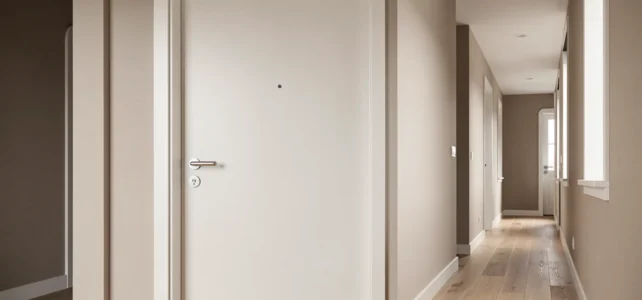
A postformed door is a panel whose facing (generally made of reconstituted wood or fiber) is molded under pressure to create surface reliefs, moldings, or patterns. This manufacturing process distinguishes it from a flat door, which remains smooth and flat. Understanding this structural difference allows for a suitable choice for each room in the house.
Manufacturing a postformed door: what the process changes concretely
The term “postformed” refers to the fact that the facing is shaped after its initial manufacturing. A sheet of MDF or HDF panel goes through a heated mold that imprints surface reliefs. This integral molding means that the moldings are not added, glued, or nailed: they are part of the panel.
This technique has a direct consequence on maintenance. The absence of joints between the moldings and the back of the panel eliminates areas where dust can accumulate. A simple wipe with a damp cloth is sufficient, whereas a door with added moldings requires more meticulous cleaning in every corner.
The molded facing in one piece also offers better moisture resistance than glued moldings, which can peel off over time in a poorly ventilated room. To delve deeper into the selection criteria on Madmoizl Déco, the topic is detailed from both decorative and practical angles.

Postformed door or flat door: comparison for choosing by room
The confusion between these two types of doors often arises. A summary table allows for visualizing the differences that matter at the time of purchase.
| Criterion | Postformed Door | Flat Door |
|---|---|---|
| Surface | Integrated moldings, visible relief | Smooth, flat |
| Style | Classic, rustic, or neoclassical | Contemporary, minimalist |
| Weight | Slightly heavier (thicker molded panel) | Lighter (frequent honeycomb structure) |
| Maintenance | Easy, no joints | Very easy, flat surface |
| Sound insulation | Variable depending on the core of the panel | Low if honeycomb structure |
The style of the room guides the choice. A postformed door with pronounced moldings suits an interior that plays on reliefs, cornices, or detailed baseboards. In a hallway or a living space with a clean design, a flat door integrates better.
The often overlooked criterion remains acoustic insulation. A lightweight honeycomb core door insulates very little from noise, regardless of its type. Recent technical guides emphasize that before changing doors, addressing air leaks (peripheral seals, door bottom) remains the most cost-effective action to improve sound comfort.
Moldings, design, and finishes: adapting the style to your interior
Postformed doors come in several molding profiles. Some mimic old-fashioned panels with two or four raised frames. Others offer more geometric lines, suitable for interiors transitioning between classic and contemporary styles.
- Two-panel models are suitable for modest-sized rooms, as the lines remain simple and do not visually overwhelm the space.
- Four or six-panel versions match reception areas or entries, where relief adds character to the decor.
- Pre-painted white finishes are the most common and allow for installation without additional painting, reducing the time to service.
The choice of finish determines the aesthetic lifespan of the door. A raw facing can be painted in the desired shade but requires a suitable primer for MDF. A pre-coated facing is difficult to repaint without prior sanding.
Coordinating doors and baseboards
A detail that competitors rarely address: the profile of the moldings of the postformed door benefits from being consistent with that of the baseboards and frames. An interior where the reliefs of the door, baseboard, and door frame share the same visual vocabulary appears more polished than a mix of styles.
Acoustic performance of a postformed door: what really matters
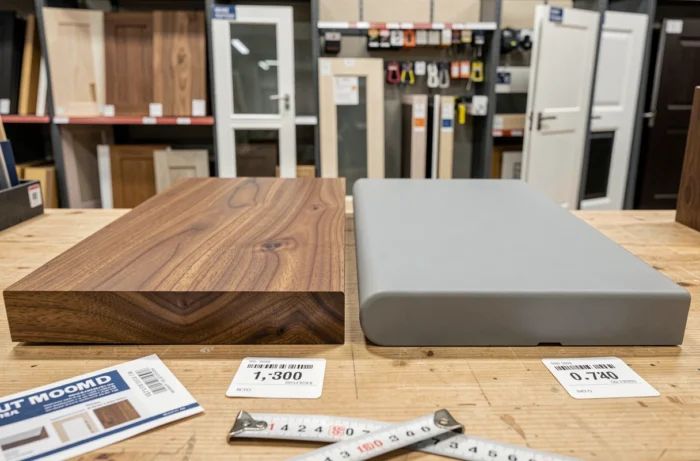
The sound insulation of a door depends less on its moldings than on the density of its core and the airtightness of its installation. A postformed door with a solid core (particle board or dense MDF) offers significantly better sound attenuation than a model with a honeycomb core, even if both have identical surface moldings.
Air leaks around the frame degrade insulation more than a thin panel. Before investing in a heavier door, checking the condition of the peripheral seals and the threshold remains the priority. An automatic threshold (which lowers to the floor upon closing) significantly improves acoustic comfort for a moderate cost.
For a bedroom or an office, opting for a postformed door with a solid core combined with new seals yields better results than a high-end door installed on a worn frame.
Installation and dimensions: pitfalls to avoid when purchasing
Postformed doors are sold in standard dimensions. Before any purchase, measuring the height and width of the existing frame avoids returns to the store. The tolerance gap between the panel and the frame should remain low to ensure acoustic and thermal airtightness.
- Check that the frame is level with a bubble level, as a warped frame prevents the door from closing properly.
- Allow sufficient clearance at the bottom for air passage if the room does not have mechanical ventilation, but not excessive enough to ruin sound insulation.
- Ensure that the hinges can support the weight of the molded panel, which is often greater than that of a honeycomb flat door.
A frame in good condition determines the performance of the door, regardless of the chosen model. In renovations, replacing only the panel without checking the frame is a common mistake that leads to closure and noise issues.
The choice of a postformed door ultimately relies on three concrete elements: the style of molding suited to the existing decor, the density of the panel’s core for acoustic comfort, and the condition of the frame that will hold the door. These three points, verified before purchase, prevent most disappointments after installation.