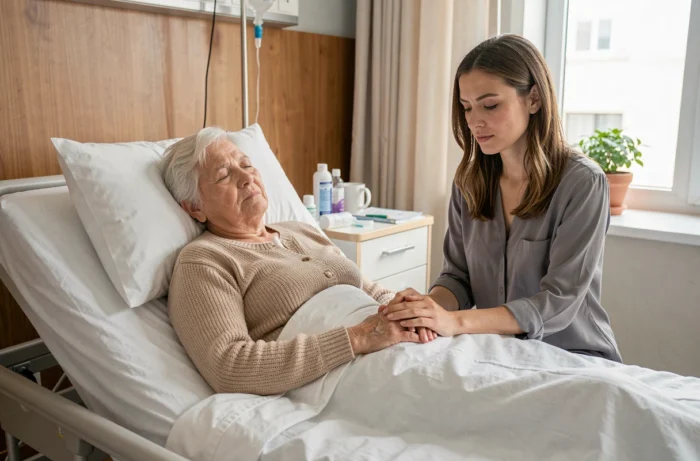
Palliative care refers to active management aimed at relieving pain and symptoms of a serious illness, without attempting to cure it. The duration varies from a few days to several years depending on the pathology, the patient’s condition, and the place of care. Understanding the stages of this support allows families to better anticipate their loved one’s journey and make informed decisions with the healthcare team.
Palliative Care and Prognosis: Why No Standard Duration Exists
A stay in a palliative care unit (PCU) does not follow any predetermined schedule. The duration primarily depends on the trajectory of the illness: a rapidly progressing cancer does not follow the same pace as heart failure or a neurodegenerative disease. A patient can be followed in palliative care for several years or just a few days.
The response to comfort treatments (analgesics, anxiolytics, supportive care) also modifies the length of stay. A patient whose refractory symptoms are stabilized may return home or be directed to a nearby facility, then return to the PCU if the situation deteriorates.
For families seeking to know how long to stay in palliative care, the honest answer is that the medical team reassesses the situation day by day, without a fixed deadline.
Factors Influencing the Duration of Palliative Support
Three main categories of factors determine the length of care.
- The nature of the illness and its stage: metastatic cancer with organ failure shortens the stay compared to a stabilized chronic illness. The progression can accelerate or slow down unpredictably.
- The place of care: home care coordinated by a mobile team can last longer than a stay in a PCU, as the patient remains in a familiar environment as long as symptoms allow.
- The wishes of the patient and their advance directives: the law recognizes the right to refuse treatment, including those that sustain life. These choices, formalized in writing or communicated by the trusted person, directly influence the duration of support.
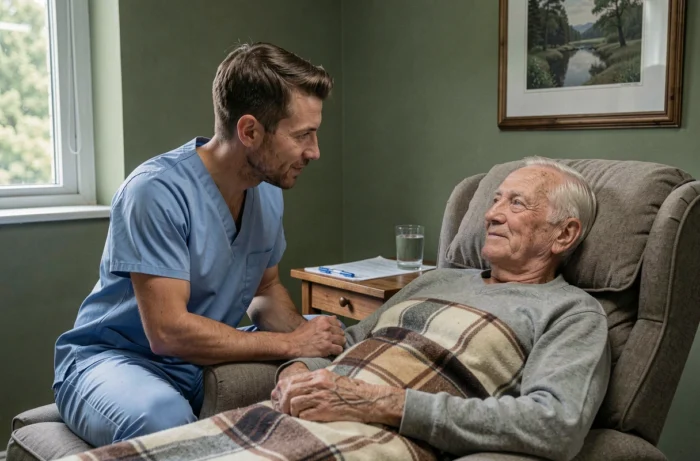
Family support also plays a role. A present and trained support network facilitates home care, while social isolation can hasten hospitalization in a PCU.
End-of-Life Stages in Palliative Care: What Happens Practically
Palliative care follows an observable progression, although each journey remains unique.
The initial phase begins with a comprehensive assessment: pain, psychological state, social and spiritual needs. The multidisciplinary team (doctor, nurse, psychologist, social worker) develops a personalized care plan. This phase can last from a few days to several weeks.
Next comes a stabilization phase where comfort treatments are adjusted. The patient may experience periods of relative improvement, sometimes sufficient for a temporary return home. Mobile palliative care teams, covering the entire territory according to the 2026 CNSPFV Atlas, then provide support.
The terminal phase is characterized by a gradual decline in vital functions. Food intake decreases, sleep periods lengthen, and communication becomes more difficult. The healthcare team continuously adapts care to avoid suffering and supports loved ones during this time.
2026 Law and Access to Palliative Care: What Changes for Patients
The law of May 26, 2026, aims to guarantee equal access to palliative care across the territory. In 2025, France still had 18 departments without a palliative care unit, according to the CNSPFV. The new law provides for the opening of at least one PCU in each department still lacking one.
It also creates a new type of facility: houses for support and palliative care, intended for stabilized patients who no longer require hospitalization but cannot return home. These houses fill a gap between the hospital and home, which should change the average length of stays in PCUs by freeing up beds for the most complex situations.
This legislative evolution is accompanied by a strengthening of mobile teams. Their role in coordinating between home, nursing homes, and hospitals becomes central to streamline the patient’s journey.
Advance Directives and Trusted Person: Anticipating to Better Guide Care
Advance directives allow any adult to express in writing their wishes regarding their end of life, including the refusal of certain treatments. They are binding on the doctor except in very specific cases (vital emergency, directives deemed manifestly inappropriate after a collegial procedure).
The designation of a trusted person complements this system. This relative or healthcare professional will be consulted first if the patient can no longer express themselves. Their testimony prevails over that of the family in the hierarchy of medical decisions.
Drafting these documents ahead of a hospitalization in palliative care helps avoid situations of blockage between the medical team and the family. It also reduces uncertainty about how to proceed as the illness progresses, which directly influences the duration and nature of support.
The duration of a stay in palliative care is not merely a medical prognosis. It results from a continuous adjustment between the progression of the illness, the patient’s choices, and the resources available in the territory. With the support houses created by the 2026 law, some stabilized patients will have a concrete alternative to prolonged hospitalization, redistributing lengths of stay among different facilities.