
DIY encompasses all repair, maintenance, and manufacturing work carried out by a non-professional person in their home. Drilling a wall to fix a shelf, replacing a faucet seal, sanding and repainting a piece of furniture: each action involves a tool, a material, and a specific technique. Therefore, starting DIY requires understanding this logic before purchasing anything.
Common DIY Materials: What Each Surface Requires
Most guides start with tools. The problem is that a tool is not chosen in absolute terms: it is chosen based on the material to be worked on. A drill bit for wood does not drill concrete, and a wood screw does not hold in drywall.
Three families of materials appear in the majority of home projects. Solid wood and its derivatives (particle board, MDF, plywood) form the basis of furniture and interior fittings. They can be cut with a saw, drilled easily, and assembled with wood screws or glue.
Plaster and drywall require specific anchors (Molly or self-drilling anchors) and low-speed drilling to avoid splintering. Finally, masonry (concrete, brick, cinder block) requires a hammer drill or percussion drill and expansion anchors.
Before any purchase, identify the walls and surfaces in your home. This step prevents the accumulation of unnecessary consumables. Those who wish to start DIY with Bricoludik will find this material-based approach detailed from the first modules.

DIY Safety: Actions That Prevent Domestic Accidents
Accidents related to home DIY represent a significant portion of everyday accidents in France. Hands, eyes, and back are the most exposed areas. Addressing safety before discussing tools is not excessive: a beginner is more often injured due to ignorance of risks than due to clumsiness.
Personal Protective Equipment
Three protections cover the majority of situations:
- Closed-side safety glasses, mandatory whenever a saw, drill, or chisel is involved. Wood, metal, or plaster splinters can reach the eyes in a fraction of a second.
- Work-appropriate gloves: cut-resistant gloves for cutting, latex or nitrile gloves for painting and solvents. A glove that is too thick reduces sensitivity and increases the risk of slipping on a tool.
- A dust mask (minimum FFP2 type) for sanding, cutting MDF, or any work generating fine particles.
Electrical Risk
Turning off the relevant circuit breaker before any intervention on an electrical circuit remains the most ignored rule by beginners. A simple switch replacement while live can cause electrocution. A voltage tester (a few euros) allows you to check for the absence of current in seconds.
Working in a clear, well-lit space, with stable feet on the ground, also significantly reduces accidents. Tidying up between each step is not perfectionism: it’s prevention.
First DIY Tools: The Versatile Basics Without Over-Equipping
The common reflex is to buy a complete 150-piece kit on sale. Most of these pieces are never used. Five hand tools and a drill-driver are sufficient for most common tasks.
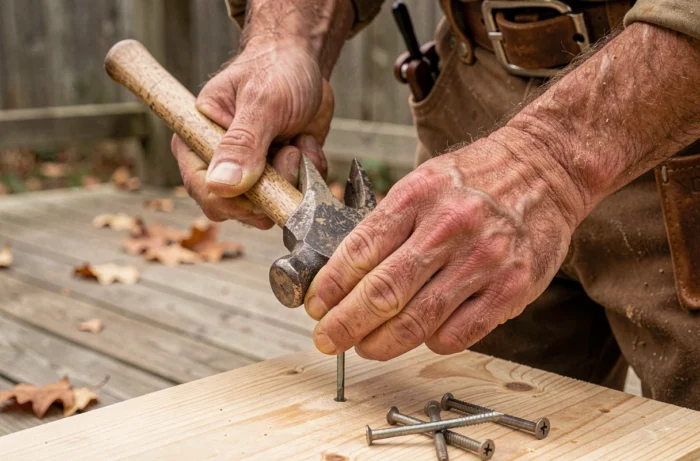
A carpenter’s hammer (about 300 g), a set of flat and Phillips screwdrivers, a universal pliers, a 5 m tape measure, and a retractable blade cutter form the basic hand toolkit. Add a spirit level for any wall installation.
The cordless drill-driver is the first electric tool to acquire. It screws, unscrews, drills wood, plastic, and, depending on the model, thin metal. Opt for a model with variable speed and a self-tightening chuck. The hammer function is a plus for anchors in lightweight concrete, but a real hammer drill will be necessary for hard masonry.
The saw remains the tool that divides beginners the most. A universal tooth hand saw cuts wood and plastic. For straight and even cuts on panels, an electric jigsaw represents a reasonable investment as a second purchase.
First DIY Project: Choose by Constraint, Not by Desire
The market trend confirms a shift: less heavy renovation, more small repairs and routine maintenance focused on purchasing power. A beginner has every interest in following this logic.
Rather than choosing an ambitious project (building a complete piece of furniture, redoing a floor), start from a real constraint: a shelf that is coming loose, a dripping faucet, a door that rubs. Solving a concrete problem teaches more than a decorative project, because the result is immediately measurable.
Each project involves a complete technical circuit: diagnosis, material choice, tool choice, action, finishing. Fixing a shelf in drywall requires understanding the allowable load, selecting the right anchor, drilling straight, and checking the level. This circuit is found in all tasks, including the most complex.
The common trap is to multiply simultaneous projects. Finishing one job before starting another helps consolidate actions and identify what is truly missing in the toolbox, rather than buying in anticipation.
The DIY market in France, despite several consecutive years of decline according to the Federation of DIY Stores, remains above its pre-Covid level. Beginners are not going against the trend: they are simply orienting themselves towards more modest and useful projects, which is the best way to learn sustainably.