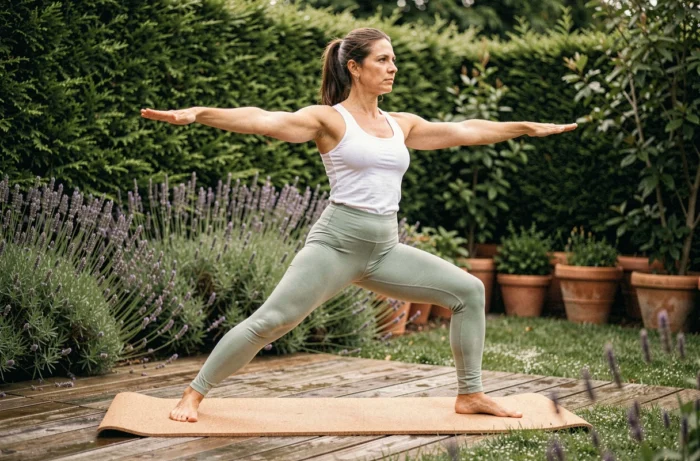
Practicing yoga in your garden is not just about moving a mat from indoors to outdoors. The combination of a green environment and a postural practice alters several physiological and cognitive parameters, sometimes distinctly different from what a studio session offers. This article measures these discrepancies based on recent data on nature exposure and yoga, to identify what truly changes in daily well-being.
Garden Biodiversity and Mental Health: An Underestimated Parameter
Articles on outdoor yoga mention nature as a calming backdrop. They overlook a determining factor: the biological richness of the practice location.
Research in nature-based mental health shows that green spaces rich in biodiversity reduce the risk of anxiety and depression. The variety of plants, the presence of birds, and pollinating insects directly contribute to better mental health indicators. A garden that is very mineral or composed of a single species of grass does not provide the same protective framework as a garden planted with shrubs, perennials, and flowering plants that attract pollinators.
Practically, this means that the design of the garden partly conditions the benefits of the yoga practiced there. Diversifying the plantings around the practice area, promoting hedgerows, or leaving a corner wild to attract beneficial insects amplifies the effect of each session. Resources like lesjardinsduyoga.fr explore this convergence between yoga practice and the relationship with living plants.
Yoga in the Garden or Yoga Indoors: A Comparison of Measured Discrepancies
To move beyond generalities, it is necessary to compare what each context brings. The table below summarizes the documented differences between indoor practice and practice in a biodiverse garden.
| Parameter | Indoor Yoga | Yoga in a Green Garden |
|---|---|---|
| Exposure to Natural Light | Variable (frequent artificial lighting) | Direct, promotes vitamin D synthesis |
| Sensory Stimulation | Limited (music, incense) | Multisensory (sounds, smells, natural textures) |
| Effect on Cortisol | Reduction linked to postural practice | Reduction enhanced by contact with plants |
| Cognitive Functioning | Improvement through meditation and breath | Superior optimization (clarity, concentration, cognitive flexibility) |
| Muscle Engagement | Flat and stable surface | Uneven surfaces (grass, soil) – increased work of stabilizing muscles |
| Surrounding Biodiversity | Absent | Associated with a reduced risk of anxiety and depression |
The right column does not describe a mere aesthetic bonus. The most notable difference concerns cognitive functioning. A review of 54 studies published in 2024 and summarized in 2026 confirms that regular exposure to nature optimizes mental clarity and cognitive flexibility, beyond merely alleviating a state of stress. Yoga practiced in a garden combines this environmental effect with the benefits specific to postures and breathing.
Breathing and Breath in the Garden: What Open Air Changes in Practice
Pranayama (breathing exercises) is a cornerstone of yoga. Practicing these exercises outdoors tangibly alters the experience.
Indoors, recirculated air limits the quality of deep inhalation. In a garden, breathing captures air rich in volatile organic compounds emitted by plants. The terpenes released by conifers, lavenders, or rosemary are documented in research on forest therapy for their effects on the parasympathetic nervous system.
For a practitioner who integrates yoga into their daily life, this difference is not trivial. A twenty-minute morning session in an aromatic garden transforms pranayama into an experience where breath interacts with the environment. The body does not work in a closed volume but in a living space, which alters the depth of relaxation felt after the session.
Adapting Postures to Natural Terrain
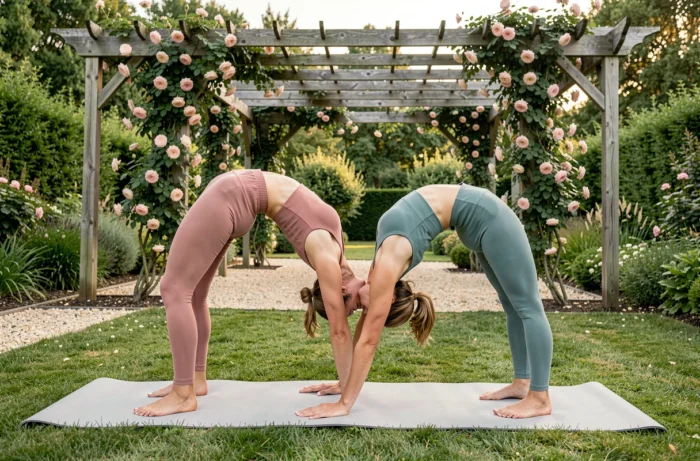
The ground of the garden is not a wooden floor. Grass, packed earth, or fine gravel introduce instability that engages deeper muscles more. Balance postures like Vrksasana (Tree) or Virabhadrasana III (Warrior III) become more demanding, and therefore more effective for proprioceptive strengthening.
- A sufficiently thick mat protects the joints without completely eliminating the irregularity of the ground, which preserves the work of stabilizers
- Sitting postures (yin yoga, meditation) benefit from a cushion or zafu to compensate for the potential moisture of the grass
- Standing sequences and sun salutations adapt well to grassy surfaces, provided to avoid steeply sloped areas
Regularity and Daily Anchoring: The Garden as a Habit Trigger
A parameter rarely addressed in comparisons concerns the immediate accessibility of the garden as a lever for regularity. Going to a studio involves travel, a fixed schedule, and sometimes a subscription. The garden eliminates these frictions.
Daily practice, even if short, produces cumulative effects on energy and emotional balance that two weekly studio sessions do not always replicate. The garden makes it possible to practice at dawn or at the end of the day, aligned with personal rhythm rather than a collective schedule.
- Defining a dedicated space in the garden (even modest) creates a spatial marker that facilitates the transition to action
- Associating practice with a fixed moment (after coffee, before dinner) anchors the habit more solidly than a vague intention
- Observing the seasonal changes in the garden during practice reinforces the feeling of connection to the living world and maintains motivation over the long term
Yoga in the garden is not just an aesthetic trend. It is the combination of a biodiverse environment and regular practice that produces the most significant differences compared to a studio session. The decisive factor remains the ecological quality of the garden itself: a planted, living, and varied space amplifies each session much more than a simple patch of mowed lawn.