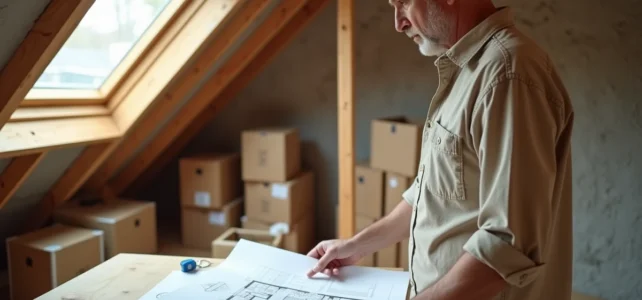
The tax qualification of an attic depends on its actual characteristics, not on the name used in the sales deed or the site plan. A raw attic under a frame, without utilities or insulation, and a partially converted attic do not generate the same cadastral rental value. Confusion persists because the administration uses a coding vocabulary (main room, secondary part, outbuilding) that most property owners do not understand.
Cadastral coding of the attic: qualification and weighting coefficient
The tax treatment of an attic in property tax depends on its qualification in the local calculation sheet. Before any measurement of area, the cadastral services classify each element of the property into three categories: main part, secondary part, or outbuilding. This hierarchy determines the weighting coefficient applied to the area.
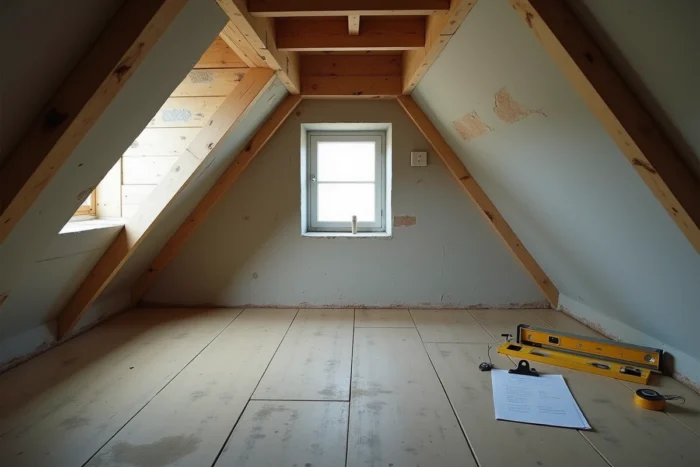
An unconvertible attic, meaning lacking water, electricity, windows, and with the floor covered in insulation, falls into the category of non-habitable outbuilding. Its weighting coefficient is very low. In certain configurations, the area may even be neutralized if the attic has no usable functionality.
The Datafoncier documentation from Cerema confirms this: the elements of a local are first qualified, then weighted to establish the rental value. We observe that whether an attic is taxable according to the tax authorities actually impacts property tax less based on its gross area than on its coding in the cadastral database.
A convertible attic (sufficient height under the ridge, presence of utilities or possible connections) will, on the other hand, be classified as a secondary part, or even a main part if it has been transformed into a living space. The weighting coefficient then increases significantly, and the area fully counts towards the calculation of the rental value.
Poorly coded attic in the tax database: correction procedure
The real estate update campaign launched in 2023 via the “Manage my real estate” service revealed a considerable volume of coding errors. Attics strictly deemed unconvertible appear as convertible attics, artificially inflating the property tax base.
A correction is possible without litigation. The tax services increasingly accept updates based on simple proof when the error is evident. We recommend compiling a file that includes:
- The plans of the property indicating the nature of the attic (non-convertible attic, lost attic), ideally from the building permit or a technical diagnosis
- Date-stamped photographs showing the absence of utilities, insulation on the floor, exposed frame, and lack of load-bearing floor
- The mention “non-convertible attic” in the notarial deed or the energy performance diagnosis, which certifies the purpose of the local
The request can be submitted via the secure messaging service of the site impots.gouv.fr or directly to the competent property tax center. The processing time varies, but the correction takes effect retroactively for the current year if accepted before the issuance of the tax roll.
Living area error and consequences on rental value
When the area of a converted attic has been overestimated in the initial declaration (model H1 for a single-family home), the cadastral rental value is based on fictitious square meters. This situation is common during construction when the form is filled out imprecisely.
The correction requires providing a contradictory measurement, carried out according to the rules of weighted area in the fiscal sense. The fiscal area is neither the living area according to the Boutin law nor the Carrez area: it incorporates coefficients related to ceiling height, material quality, and the geographical location of the property.
Conversion of an attic and declaration obligation for property tax
Transforming an attic into a habitable room modifies the characteristics of the local and triggers a declaration obligation within 90 days of the completion of the work. The relevant form is model IL (form 6704), to be submitted to the property tax center.
Failure to make this declaration exposes one to reassessment. The administration can reconstruct the converted area from cross-referenced data: building permit, prior declaration of work, aerial orthophotographs, or reporting during a field inspection.
Concrete impact on the amount of property tax
The addition of living area through attic conversion increases the cadastral rental value, which is then multiplied by the rates voted by the municipality and the intermunicipality. The annual revaluation coefficient also applies to this new base: in 2025, it was set at 1.068, representing a flat increase of 1.7% on built properties.
We observe that the impact strongly depends on the municipality. In a city where the cumulative property tax rate exceeds the average, a few additional square meters of main area can represent a significant annual increase.
- Attic left as is (non-convertible): low or no weighting, marginal impact on property tax
- Convertible attic but not converted: classified as a secondary part, intermediate weighting
- Converted attic into a living room: classified as a main part, full weighting, mandatory declaration
Check the cadastral sheet of your attic on impots.gouv.fr
The “Manage my real estate” service allows you to consult the descriptive sheet of each local. Each room or element is listed with its category, area, and allocation. If a non-convertible attic appears with an inappropriate qualification, this is the starting point for any corrective action.
The sheet does not directly mention the weighting coefficient applied, but the category of the local (main, secondary, outbuilding) allows one to deduce its weight in the calculation. An attic without utilities or flooring should never be listed as a main part.
Owners who filled out the occupancy declaration in 2023 without checking the details of the listed rooms have sometimes validated erroneous information inherited from the old cadastral matrix. Correcting this sheet remains possible at any time, and the process incurs no administrative fees.