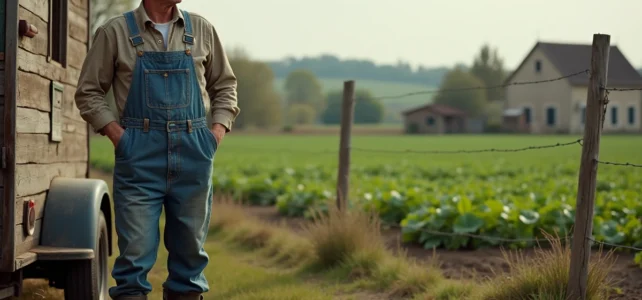
Sleeping on agricultural land raises a question that many underestimate: the legal framework does not always clearly distinguish between a night in a tent and a permanent installation. Between zoning classification, the type of habitat used, and the duration of occupation, the parameters that determine legality vary greatly. This article measures the discrepancies in treatment based on the type of accommodation and the duration of presence on a plot classified as zone A.
Regulatory comparison based on the type of installation on agricultural land
The legal treatment of a night spent on agricultural land primarily depends on what you place on the ground. A tent, a van, a caravan, or a mobile home are subject to different urban planning rules, and the thresholds of tolerance differ.
| Type of installation | Duration without formalities | Beyond the threshold | Main risk |
|---|---|---|---|
| Tent | Occasional bivouac (one night, dawn) | Repeated occupation = possible reclassification | Fines from the mayor |
| Van or camper | Brief parking on accessible road | Prior declaration if prolonged presence | Order to vacate the premises |
| Caravan | Less than 3 months cumulatively over 12 months | Prior declaration or permit depending on area | Criminal prescription extended to 10 years from 2026 |
| Mobile home / light habitat | No tolerance in zone A except for direct link to the farm | Building permit required | Demolition ordered by the court |
This table highlights a gradient: the heavier and more anchored the installation, the stricter the framework becomes. The caravan occupies a pivotal position, as it easily shifts from the status of a mobile vehicle to that of a construction as soon as it loses its mobility (wheels removed, fixed connections, permanent awning).
As detailed in Guide Immo articles, the boundary between temporary occupation and permanent installation relies on concrete indicators that urban planning services verify during inspections.

Criminal prescription and the cabanisation law: what changes in 2026 for caravans
The most significant data for anyone considering sleeping regularly on agricultural land concerns the extension of the prescription period. The so-called “cabanisation” bill, which comes into effect in 2026, has extended the criminal prescription period to 10 years for caravans illegally installed on agricultural land. The standard prescription for urban planning offenses remains at 6 years.
This four-year difference is not trivial. It means that a permanently placed caravan on a plot of agricultural land exposes its owner to prosecution long after the physical departure of the installation. A report drawn up in 2026 could therefore concern events dating back to 2016.
In contrast, a tent set up for a single night of bivouac does not fall under this stricter regime. The legislator specifically targets installations that effectively change the purpose of the land.
Quarterly rotation between agricultural plots: a false legal workaround
A common idea is to change plots every three months to remain within the framework of temporary installations and escape the regime of permanent housing. This strategy no longer works.
Administrative doctrine and case law now consider that rotation between plots does not constitute temporary use if the intention to inhabit continuously is demonstrated. The indicators retained by the courts are concrete:
- Presence of fixed furniture or sanitary facilities connected, even summarily, to a sewage or water network
- Receipt of mail or administrative domicile at the plot’s address
- Signs of land development (gravel, slabs, created access paths) that betray structured occupation
- Frequency of movements deemed artificial compared to a real agricultural use of the land
An agricultural operator who occasionally sleeps on their own plot during a harvest or livestock monitoring period finds themselves in a legally distinct situation. The direct link to agricultural activity remains the determining criterion to justify nighttime presence in zone A.
Farm camping: the only stable legal framework for accommodating sleepers
The only configuration that allows people to sleep on agricultural land sustainably without the risk of reclassification is declared farm camping. This system allows an operator to host campers on their plot, subject to a declaration at the town hall and compliance with safety standards applicable to camping grounds.
This status has a major advantage: it does not alter the classification of the plot as agricultural land. The land retains its purpose, and hosting campers is considered a complementary activity to the farm. Networks of farms also offer free or low-cost spots to travelers in vans or tents, within a declared framework.
Preliminary checks before sleeping on agricultural land
Before any installation, even for a single night, several checks can reduce the risk of infringement. The urban planning code does not provide a uniform regime for bivouacking in zone A, making consultation of local regulations essential.
- Consult the PLU at the town hall to confirm the exact classification of the plot (strict zone A, zone Ah allowing habitation, or protected zone Ap)
- Check if a municipal order prohibits wild camping in the municipal territory, which would make even a one-night bivouac subject to a fine
- Obtain written consent from the owner if you are not the operator of the plot
- Ensure that the installation remains entirely reversible: no anchoring to the ground, no permanent connections
The mayor’s police power allows them to observe any occupation deemed incompatible with the agricultural purpose of the land. A simple visit from a municipal agent is enough to trigger a procedure.
The parameter that weighs most heavily in the legal assessment remains the cumulative duration. Three months out of twelve represents the threshold beyond which prior declaration becomes mandatory for a caravan. For a mobile home or light habitat without wheels, no temporal tolerance applies in zone A, unless the installation is directly linked to the agricultural operation of the plot.